Before the maths
This page explains how the numbers work. It is not a recommendation to take anything, and it is not a prescription. Several compounds named here are not approved for people in any country. Getting the arithmetic right does not make a compound safe.
The units
- mg
- Milligram. Measures the dry powder. Vials usually hold 2mg to 30mg.
- mcg
- Microgram. Much smaller. 1 mg = 1000 mcg. Learn this one cold.
- mL
- Millilitre. Measures liquid, such as the water you add to the vial.
- units
- What an insulin syringe is marked in. 100 units = 1 mL.
- IU
- International unit. Used for growth hormone and HCG. An IU means something different for every compound, so you can never convert IU from one drug to another.
Concentration is the whole game
Concentration means how much drug sits in each millilitre of liquid.
Think about coffee. An espresso is a lot of coffee in a little water. An americano is the same coffee in more water. Same amount of coffee, very different strength per mouthful. Your vial works the same way.
Concentration = how much drug ÷ how much water you added
Say you have a 10mg vial and you add 2mL of water:
- 10mg ÷ 2mL = 5 mg per mL
- In micrograms: 5 × 1000 = 5000 mcg per mL
Working out one injection
Volume to inject = the dose you want ÷ the concentration
Here it is start to finish, using a 5mg vial of BPC-157 and a 250mcg dose.
- Find the concentration. 5mg ÷ 2mL = 2.5 mg/mL. Times 1000 = 2500 mcg/mL.
- Find the volume. 250mcg ÷ 2500 mcg/mL = 0.1 mL.
- Turn it into syringe units. 0.1mL × 100 = 10 units.
Three more worked examples
| Compound | Vial | Water | Dose wanted | Concentration | Inject |
|---|---|---|---|---|---|
| Semaglutide | 5 mg | 2 mL | 250 mcg | 2500 mcg/mL | 0.1 mL = 10 units |
| CJC-1295 | 2 mg | 2 mL | 100 mcg | 1000 mcg/mL | 0.1 mL = 10 units |
| Growth hormone | 10 IU | 1 mL | 2 IU | 10 IU/mL | 0.2 mL = 20 units |
Reading the syringe
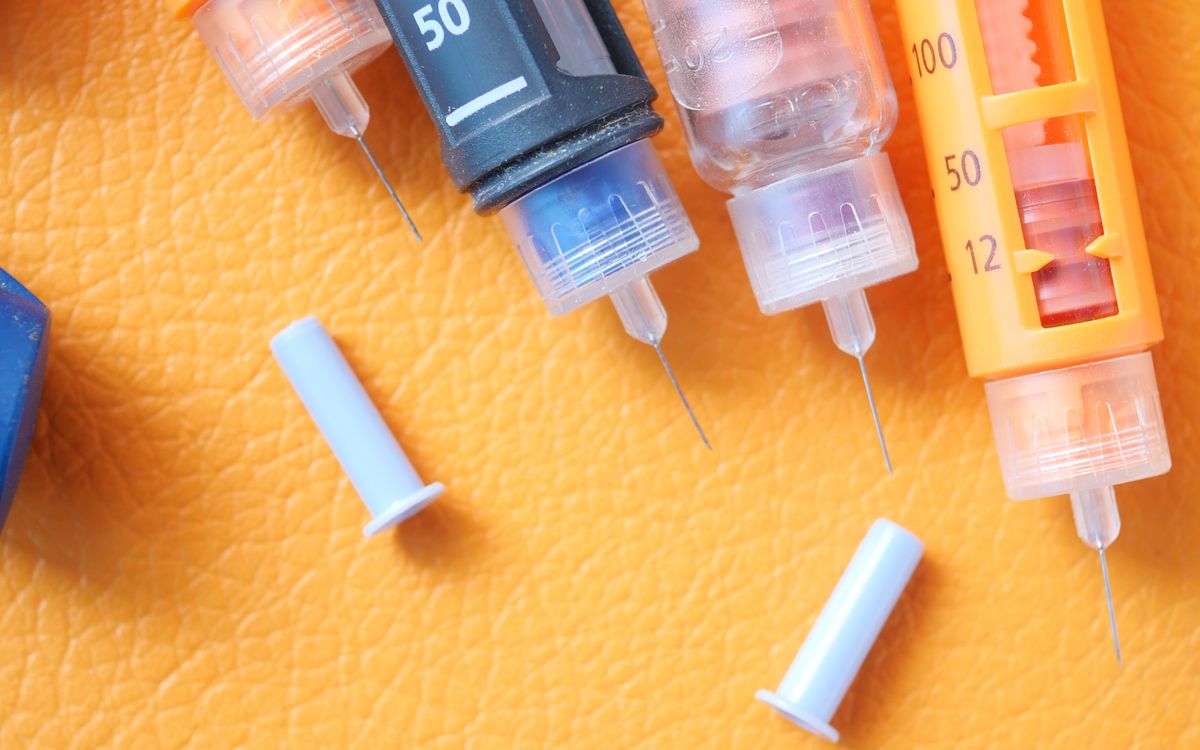
Insulin syringes are the usual choice. They are marked from 0 to 100 units, and 100 units is 1mL. So you just move the decimal point two places: 0.1mL is 10 units, 0.25mL is 25 units.
Standard syringes are marked in millilitres instead. The gap between the small lines is not the same on every syringe. Read the numbers printed on the barrel and count the lines on the one in your hand. Do not assume it matches a syringe you used before.
Check your answer
- Does the volume look sane? Most peptide injections come out between 0.05mL and 0.5mL.
- Work backwards. Volume × concentration should give you the dose you started with.
- If the number looks wild, it is. A huge or tiny volume nearly always means a unit conversion went wrong.
How much water to add
The amount of water is your choice, and it changes everything downstream.
- More water: bigger injection volumes, easier to measure small changes, vial empties sooner.
- Less water: smaller volumes, vial lasts longer, harder to measure precisely.
If your sum tells you to inject more than about 0.5mL, that is usually a sign to use less water next time. Between 1mL and 2mL is the common middle ground.
Testosterone: scaling to body weight
Testosterone doses are sometimes worked out from body weight rather than picked out of the air. The rough reference points people use:
- 1 mg per kg — conservative
- 2 mg per kg — standard
- 3 mg per kg — higher end
Someone at 90kg aiming for the middle: 90 × 2 = 180mg per week.
Two things to be clear about. People respond very differently, so this is a reference point and not a prescription. And testosterone is a controlled drug in the United States and many other countries, which puts it in a different legal category from the peptides on the rest of this page.
The mistake that matters most
Mixing up mg and mcg is a 1000x error
One milligram is a thousand micrograms. Confuse the two and your dose is a thousand times too big or a thousand times too small. This is the error that hurts people.
Recalculate from scratch any time you change the vial size, the amount of water, or the dose. Changing one changes all of them.
Check it twice. Use a calculator, or work it a second way, or have someone else run the numbers.
If you are unsure, less is the safer direction to be wrong in.
Think we got something wrong? Here is how we fix mistakes.